




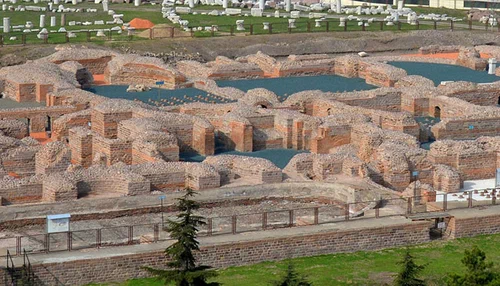
Located on Çankırı Street, which stretches from Ulus to Yıldırım Beyazıt Square, the Roman Baths are built in the 3rd century by Roman Emperor Caracalla, son of Septimus Severus, in honor of the god of health, Asklepios. This platform, now called the Roman Baths, is actually a large mound, with Roman-era remains at the top and Phrygian settlement remains below. The stone remains beneath the mound are very well preserved, allowing us to understand the structure's plan. This suggests that the baths were built to imperial standards rather than those of a provincial city. The baths are 80 by 100 meters in size and are constructed of stone and brick. The entrance from Çankırı Street leads to a large area surrounded by the remains of a colonnaded portico, known as the Palaestra, where physical training and wrestling matches were held. Although damaged by a fire in the 7th century, coins found during excavations indicate that the structure was used for approximately 500 years and was repaired periodically. Between 1938 and 1943, archaeological excavations conducted by the Turkish Historical Society uncovered the changing and bathing areas of the bathhouse, as well as the underground furnace and service passages.